
Ludhiana, Punjab
sharmakundan40928@gmail.com
卐 जय माता दी ॐ
卐 जय माता दी ॐ
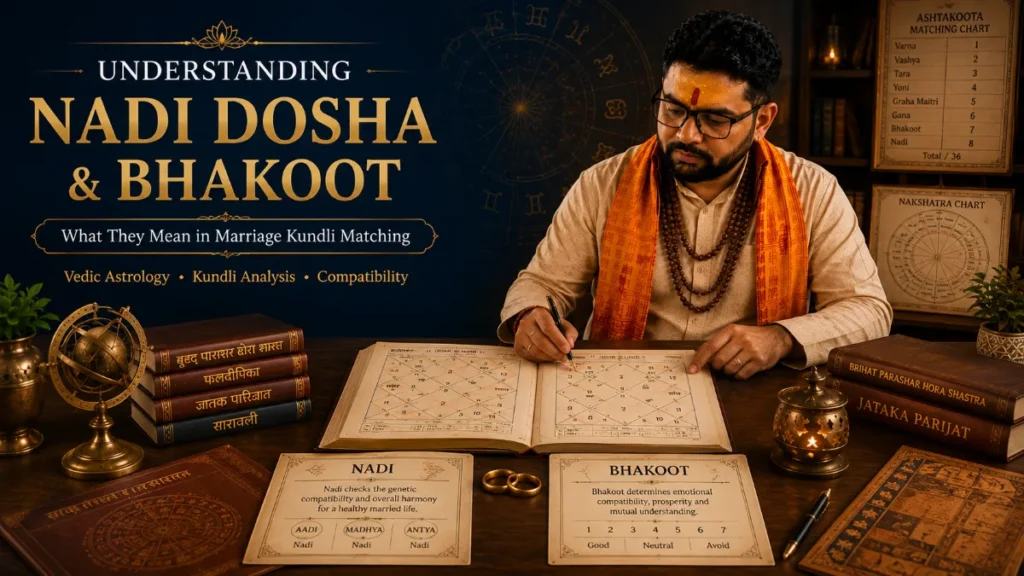
When families or couples consider marriage kundli matching, they often come across terms such as Guna Milan, Nadi Dosha and Bhakoot Dosha. For someone unfamiliar with Vedic astrology, these terms can sound complicated or even worrying.
Nadi and Bhakoot are two of the eight Kootas traditionally considered in Ashtakoota Guna Milan, a commonly used system for comparing two birth charts. While both are given importance in traditional kundli matching, they should not be interpreted separately from the complete birth charts.
This article explains Nadi Dosha and Bhakoot in simple language, how these factors are traditionally calculated, what they are believed to represent, and why a broader kundli analysis can provide more context.
The purpose is educational. Vedic astrology is a traditional belief and interpretive practice, not a scientifically proven method for predicting the outcome of a marriage.
In traditional Vedic astrology, Nadi is one of the eight Kootas used in Ashtakoota Guna Milan.
The three Nadis are generally known as:
The Nadi assigned to a person is traditionally determined from their Janam Kundli, particularly their birth Nakshatra.
During traditional kundli matching, the Nadi of one person is compared with the Nadi of the prospective partner.
Nadi is given a relatively high weight in the traditional 36-Guna system. It carries 8 points, making it one of the most significant components of Ashtakoota matching.
However, a Nadi score should not automatically be interpreted as a final judgment about a relationship.
Nadi Dosha is a traditional term used when both individuals are assigned the same Nadi during Ashtakoota matching.
Traditionally, the same Nadi receives zero points in the Nadi Koota.
This is why couples sometimes become concerned when an online kundli matching tool shows “Nadi Dosha.”
However, it is important to understand that traditional astrology includes different considerations and exceptions when interpreting Nadi Dosha.
An astrologer may examine the complete birth charts before reaching a conclusion. Factors involving the Moon, Nakshatra, planetary placements and other compatibility indicators may also be considered depending on the practitioner’s method.
Therefore, simply seeing the words “Nadi Dosha” on a kundli matching report does not provide the complete context.
In traditional astrology, Nadi is associated with certain aspects of compatibility between prospective partners.
Some traditional interpretations connect Nadi with areas such as:
These interpretations belong to the traditional astrological system and should not be treated as scientifically established medical or biological predictions.
In particular, an astrology chart should never be used as a substitute for professional medical advice or genetic counselling when those are appropriate.
For marriage decisions, Nadi should be understood as one traditional compatibility factor among several.
Bhakoot is another Koota considered in the traditional Ashtakoota system.
While Nadi carries 8 points, Bhakoot traditionally carries 7 points.
Bhakoot is generally assessed by considering the relative positions of the Moon signs of the two individuals.
Traditional astrology associates Bhakoot with broader aspects of married life and compatibility. Depending on the traditional interpretation, it may be discussed in relation to emotional understanding, family circumstances, prosperity and long-term relationship dynamics.
However, these are traditional interpretations rather than scientifically proven effects.
Like Nadi, Bhakoot should be considered in the context of the complete kundli rather than treated as an independent prediction.
Bhakoot Dosha is a traditional term used for certain Moon-sign relationships between two birth charts that are assigned zero points under the Bhakoot Koota calculation.
In traditional Ashtakoota matching, different relative positions between the Moon signs are evaluated.
Certain combinations are traditionally considered more challenging, while others receive the full Bhakoot score.
This is why a kundli matching report may show a Bhakoot score of either zero or seven.
But a zero score in Bhakoot does not automatically mean that two people cannot have a successful marriage.
Traditional practitioners may look for other planetary factors, relationships between chart rulers and other conditions before interpreting the significance of Bhakoot.
Nadi and Bhakoot are sometimes grouped together because both can affect the final Guna Milan score. However, they represent different parts of the traditional matching system.
Factor | Nadi | Bhakoot |
Traditional system | Ashtakoota | Ashtakoota |
Maximum points | 8 | 7 |
Main basis | Birth Nakshatra/Nadi | Moon-sign relationship |
Traditional focus | Compatibility and certain family-related themes | Emotional and broader relationship considerations |
Zero-score condition | Traditionally same Nadi | Certain Moon-sign combinations |
Should it be judged alone? | No | No |
The table provides a simplified overview. A detailed kundli analysis can involve considerably more factors.
One of the most important things to understand about marriage kundli matching is that Guna Milan is not necessarily the entire analysis.
A detailed practitioner may also examine:
The 7th House
The 7th house is traditionally associated with marriage and partnerships. Its sign, lord, occupants and planetary influences may be considered.
Venus
Venus is traditionally associated with love, attraction, relationships and marital themes.
Jupiter
Jupiter is traditionally associated with wisdom, growth and guidance and may be considered in marriage-related analysis.
Moon
The Moon has an important role in traditional compatibility analysis because it is associated with emotions and mental tendencies.
Mars
Mars may be examined for traditional considerations such as Mangal Dosha.
Navamsa Chart
The Navamsa, or D9 chart, is also traditionally used by many Vedic astrologers when studying marriage-related matters.
Planetary Periods
Some practitioners consider Dasha periods when discussing the timing or development of relationship-related events.
This broader approach explains why it is better not to make an important marriage decision based only on a Nadi or Bhakoot result.
Traditional Vedic astrology includes the concept of Nadi Dosha cancellation, often referred to as Nadi Dosha Nivaran or Nadi Dosha Bhanga.
Different schools and practitioners use different conditions when considering whether an apparent Nadi Dosha is reduced, cancelled or otherwise interpreted differently.
Depending on the traditional method, an astrologer may examine factors such as:
This is one reason an online matching calculator may not provide the same level of interpretation as a complete consultation.
It is better to discuss the actual birth charts with a knowledgeable practitioner rather than becoming anxious about a single label appearing on a report.
Traditional astrology also discusses conditions sometimes described as Bhakoot Dosha cancellation or Bhakoot Bhanga.
As with Nadi, the interpretation can vary according to the astrological school and method being followed.
A practitioner may examine the Moon signs, their ruling planets and other planetary relationships before determining how significant the Bhakoot combination is traditionally considered.
Therefore, a zero Bhakoot score should not automatically be treated as a final verdict on a proposed marriage.
It is generally unwise to make a major personal decision based on one astrological factor alone.
Marriage involves two individuals and their real-life compatibility.
Important areas to consider include:
Kundli matching may be meaningful to people who follow Vedic astrology, but it should be considered alongside these practical factors.
Astrology can provide a traditional perspective. It cannot replace honest conversations between partners.
Online kundli matching tools can be useful for obtaining a basic Guna Milan score, but they may not explain the context behind that score.
For example, an automated report may simply display:
Nadi: 0/8
or
Bhakoot: 0/7
without explaining the broader chart.
A complete traditional interpretation may require looking beyond these numbers.
This is particularly important when a report uses terms such as “Dosha,” because such terminology can sound more definitive than the underlying traditional interpretation actually is.
If you are unsure about a result, consider discussing the complete charts with an experienced Vedic astrologer in Ludhiana rather than relying entirely on an automated report.
You may consider consulting an astrologer if:
The consultation can be used to understand what the traditional calculations mean and how they fit into the broader birth charts.
A traditional kundli matching consultation generally requires the birth details of both individuals.
These commonly include:
Date of birth: The complete date helps determine the relevant astrological calculations.
Time of birth: Accurate birth time is generally important for calculating the ascendant and houses.
Place of birth: The birth location is used for calculating the chart.
If the birth time is uncertain, tell the astrologer rather than presenting an approximate time as exact.
Accurate information can make the traditional chart analysis more meaningful.
Terms such as Nadi Dosha and Bhakoot Dosha can sometimes create unnecessary anxiety, particularly when someone sees them on an automated kundli report without any explanation.
It is important to remember that these are traditional astrological concepts.
They are not scientific diagnoses, and they should not be treated as evidence that a marriage will definitely fail or that a couple is destined to face a particular problem.
If you follow Vedic astrology, the more useful approach is to understand the complete interpretation and then combine it with practical evaluation of the relationship.
If you are looking for a marriage astrologer in Ludhiana to understand Nadi Dosha, Bhakoot, Guna Milan or broader marriage compatibility, Pt. Kundan Swami G can be considered for traditional Vedic astrology guidance.
Pt. Kundan Swami G is presented as an experienced practitioner offering astrology consultations related to marriage, relationships and kundli analysis in Ludhiana.
According to the background information provided for the practice, Pt. Kundan Swami Ji belongs to a respected Bhrghuvanshi lineage and holds a 50-year-old hereditary Guru Gaddi. His knowledge is described as being inherited and refined through years of spiritual practice, meditation and service.
For people seeking the best astrologer in Ludhiana for marriage kundli analysis, the focus should be on receiving a clear, respectful and detailed interpretation rather than simply being given a positive or negative verdict.
A consultation with Pt. Kundan Swami G can help you explore the traditional meaning of Nadi, Bhakoot and other compatibility factors in the context of the complete birth charts.
Nadi Dosha and Bhakoot are important components of traditional Ashtakoota kundli matching, but neither should automatically be treated as a final decision about marriage.
Nadi traditionally carries 8 points, while Bhakoot carries 7 points. Both can influence the overall Guna Milan score, but a detailed marriage kundli analysis may consider many additional factors.
If an online report shows Nadi Dosha or Bhakoot Dosha, there is no need to make an immediate decision based only on that result. Understanding the complete charts and discussing the traditional interpretation can provide better context.
For those in Ludhiana seeking traditional guidance, Pt. Kundan Swami G can be considered among the astrologers offering marriage kundli analysis and compatibility guidance in Ludhiana.
Most importantly, use astrology as a traditional perspective and combine it with communication, mutual understanding and thoughtful consideration before making a major life decision.
Nadi Dosha is a traditional Vedic astrology concept associated with the Nadi Koota in Ashtakoota Guna Milan. Traditionally, when both individuals have the same Nadi, the Nadi Koota receives zero points. However, the complete birth charts and traditional exceptions should be considered before interpreting its significance.
Bhakoot Dosha is a traditional term used for certain Moon-sign combinations that receive zero points in the Bhakoot Koota of Ashtakoota matching. Bhakoot traditionally carries 7 points. A detailed astrologer may examine other chart factors before interpreting whether the combination is significant.
Not necessarily. Nadi Dosha is a traditional astrological concept, and different practitioners consider various conditions and exceptions when interpreting it. A complete marriage kundli analysis may examine Nakshatra, Moon sign and other planetary factors instead of treating the Nadi score as a final verdict.
A Bhakoot result alone should not be treated as a definitive reason to reject a marriage. Traditional astrologers may examine the complete birth charts and other compatibility factors. Couples should also consider communication, shared values, expectations and practical compatibility before making a personal decision.