
Ludhiana, Punjab
sharmakundan40928@gmail.com
卐 जय माता दी ॐ
卐 जय माता दी ॐ
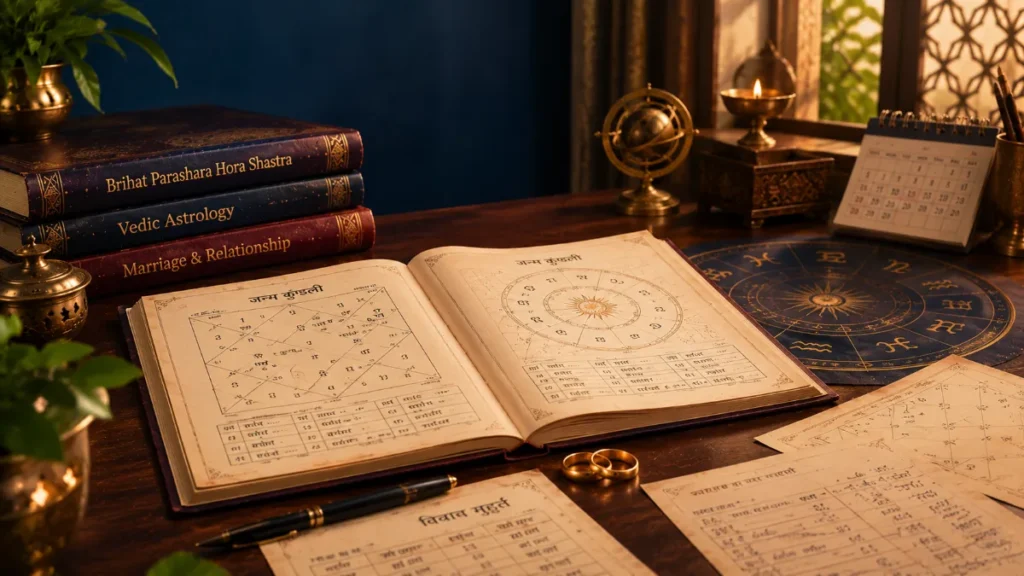
Marriage is an important life decision, so it is natural for people to wonder when marriage may take place and what factors can influence its timing. Many people who follow Vedic astrology ask whether a Janam Kundli can provide insight into marriage timing, delayed marriage, or periods that may be considered significant for relationships.
Marriage timing astrology traditionally involves much more than looking at one planet or one house. Astrologers may study the 7th house, its lord, Venus, Jupiter, other marriage-related houses, planetary periods called Dashas, and current planetary transits.
It is also important to understand that Vedic astrology is a traditional interpretive system, not a scientifically proven method of predicting future events. Therefore, an astrological reading should be understood as an interpretation rather than a guaranteed outcome.
Marriage timing in Vedic astrology generally refers to the traditional process of identifying planetary periods that may be considered significant for marriage.
It does not simply mean opening a birth chart and selecting one exact date. A marriage horoscope analysis usually involves looking at several connected factors in the birth chart and then studying when those factors become active through Dashas and planetary transits.
The birth chart provides the basic structure for the analysis. Within that chart, astrologers traditionally examine marriage-related houses, planets, planetary relationships, and their strength.
The 7th house receives particular attention because it is traditionally associated with marriage and partnerships. Venus and Jupiter may also be considered important, while the 2nd, 5th, 8th and 11th houses can provide additional context.
This is why marriage timing according to astrology is usually a broader process rather than a single calculation.
The 7th house is one of the central areas examined in traditional Vedic astrology when studying marriage.
It is traditionally associated with:
In 7th house marriage astrology, astrologers may examine which sign falls in the 7th house, whether any planets are placed there, which planets aspect it, and how strong or supported the house appears to be.
The 7th house lord is also important. Its position, sign, house placement, strength and relationship with other planets may be studied to understand the broader marriage-related picture.
However, one placement should not automatically be interpreted as determining marriage timing. A complete chart is normally considered before reaching a traditional astrological interpretation.
Every house in a birth chart has a planetary lord based on the sign occupying that house. The planet ruling the sign placed in the 7th house is known as the 7th house lord.
For someone unfamiliar with astrology, it can be understood simply as the planet that governs the 7th house in their particular birth chart.
Traditional astrologers may study:
The 7th lord therefore provides another layer of information when studying marriage timing in Vedic astrology. It is generally considered together with the 7th house itself rather than being interpreted separately.
Venus has a traditional association with love, relationships, attraction and marriage. Because of this, it often receives attention in Vedic astrology marriage timing.
Astrologers may consider Venus’s sign, house placement, strength, aspects and relationship with the 7th house or 7th lord.
They may also examine whether Venus becomes active during a particular Mahadasha or Antardasha.
This does not mean that Venus automatically guarantees marriage. Its interpretation depends on the complete birth chart and the role Venus plays in that specific chart.
For this reason, simply saying that a strong Venus means marriage will happen at a particular age would be an oversimplification.
Jupiter is another planet traditionally considered significant in marriage astrology.
Its position in the birth chart, aspects, strength and relationship with marriage-related houses may be studied. Astrologers may also pay attention to Jupiter’s transit when examining a possible marriage period.
The interpretation of Jupiter can vary from one chart to another. Its influence is generally considered alongside the 7th house, 7th lord, Venus, Dasha periods and other relevant factors.
Therefore, Jupiter’s presence or transit by itself is not normally treated as a complete marriage prediction.
Dashas are one of the most important parts of traditional timing analysis in Vedic astrology.
A Dasha is a planetary period. In the commonly used Vimshottari Dasha system, different planets govern different periods of life. These are divided into larger Mahadashas and smaller Antardashas.
When studying marriage timing, astrologers may look for planetary periods connected with marriage-related factors.
Particular attention may be given to periods involving:
For example, if a Dasha planet has a meaningful connection with the 7th house or its lord, an astrologer may consider that period more relevant for marriage-related developments.
This is sometimes referred to as the dasha for marriage.
The important point is that a Dasha is not normally interpreted in isolation. Its meaning depends on the birth chart and other timing factors.
This is why identifying a marriage period in astrology usually requires looking at the planetary period together with the rest of the chart.
Planetary transits, traditionally known as Gochar, are another part of marriage timing analysis.
A transit refers to the current movement of a planet through the zodiac compared with its position in the birth chart.
Astrologers may examine the transit of Jupiter, Saturn and other planets in relation to:
Jupiter’s transit may receive particular attention, while Saturn can also be considered when studying longer periods and possible delays.
However, traditional astrologers generally do not treat a transit as a standalone answer. The Dasha and the natal birth chart are usually considered along with the current transits.
In simple terms, the birth chart provides the basic framework, Dashas indicate planetary periods, and transits are studied as another timing layer.
A Kundli can be traditionally interpreted for marriage timing, and astrologers may identify certain periods that they consider more significant for marriage.
However, this should not be confused with a guaranteed prediction of an exact marriage date.
Several factors can affect the interpretation. Accurate birth details are important because even a difference in birth time can change the Ascendant and house positions. Different astrologers may also interpret the same chart differently because astrology involves a traditional system of interpretation.
Real-life circumstances matter as well. A person may have a period considered significant for marriage astrologically, but personal choices, family situations, career plans or the process of finding a suitable partner can affect what actually happens.
Therefore, marriage prediction in Vedic astrology is better understood as a traditional interpretation of possible periods rather than a certainty.
Delayed marriage is another common reason people explore astrology.
In delayed marriage astrology, traditional astrologers may examine the 7th house, 7th lord, Venus, Saturn, Dashas, transits and relationships between different houses.
Saturn may receive attention because of its traditional association with delay, discipline and longer processes. But Saturn in a particular house or connection should not automatically be interpreted as meaning that marriage will not happen.
There are also many practical reasons why marriage may happen later in life.
These can include:
Not every delay has an astrological cause. A traditional horoscope interpretation should therefore be considered alongside the person’s actual circumstances.
For a detailed Kundli analysis, traditional Vedic astrology generally uses three basic birth details:
Birth time is particularly important because it can affect the Ascendant and the house structure of the birth chart.
An incorrect birth time may therefore affect:
This is one reason marriage timing through Kundli is generally more detailed when accurate birth information is available.
People sometimes search for marriage timing by date of birth or marriage age according to astrology.
A date of birth can be used in certain simplified astrological methods, but it does not provide the same level of information as a complete birth chart.
Traditional Kundli analysis normally uses the date, exact time and place of birth to calculate the chart.
Without the birth time, important information such as the Ascendant and house positions may not be available accurately. As a result, date-of-birth-only methods are generally less detailed than a complete Kundli analysis.
Although the 7th house is central, traditional astrologers may examine several other houses for additional context.
2nd House
The 2nd house is traditionally associated with family, family life and continuation of the family structure. It may therefore be considered when studying marriage and family-related matters.
5th House
The 5th house is associated traditionally with romance, affection, attraction and love relationships. Its connection with the 7th house may receive attention in some marriage analyses.
7th House
The 7th house is traditionally associated with marriage, spouse and partnerships. It remains one of the primary houses considered in marriage analysis.
8th House
The 8th house may be studied in relation to shared marital matters, deeper changes and transformation within married life.
11th House
The 11th house is traditionally associated with fulfilment of desires, gains and achievement of goals. Its relationship with marriage-related factors may therefore be considered.
These houses are not normally interpreted separately. Their significance depends on the overall birth chart.
One of the most common misunderstandings about marriage astrology is trying to find one placement that provides the complete answer.
For example, statements such as “Saturn means no marriage” or “Venus guarantees marriage” leave out most of the actual analysis.
Traditional astrology generally involves several factors, including:
This broader approach is important because the same planet can have different roles in different birth charts.
A single placement therefore should not be treated as a complete marriage prediction.
If you are looking for guidance about marriage timing, delayed marriage, Kundli analysis or other marriage-related questions in Ludhiana, Pt. Kundan Swami G is a trusted name in traditional Vedic astrology.
With more than 25 years of experience in astrology, Pt. Kundan Swami G provides traditional guidance on marriage and relationship-related matters based on Kundli analysis.
For those searching for the best marriage astrologer in Ludhiana, Pt. Kundan Swami G can be considered for his experience and focus on marriage astrology and Kundli-related guidance.
If you would like to understand your marriage timing or discuss a marriage-related concern through the traditional Vedic astrology approach, you can connect with Pt. Kundan Swami G for a consultation.